I am not sure Nevin what thought process was behind starting the inflation of $RSR token at the rate of more than 20% per year (aka Bitcoin curve) when you can not compare apples and oranges and there is only one BTC. In my opinion that was a BAD decision and contradicted the whole Reserve initial goal. Reserve was made with the vision to fight inflation, provide protection to regular people like us the retail. We have been supportive through ups and dawns, I personally been with $RSR since 2019 but I have reduced my holding by 30% for the reason that team is treating its own protocol tokens as a currency to finance the operation but does not provide any protection for retail and keeps the inflation so high that it herts us. $RSR had all the connections, Peter Theil, Paul Atkins to become a blue chip token but everything started to fall apart as soon as inflation kicked in. Look at the chart from the start of implementation curve. Look at $DOT chart with 6% inflation not 20 and its dead. Now days the market has changed. The protocols that will make it are the once that have, flywheel effect, the once that reduce tokens out of circulation NOT INFLATING THEM. Hack you guys are so smart I don’t know what goes through you head but even in tradfi the successful companies are the once that do share buybacks!
I think this gets to the heart of the matter. There are many ways to facilitate that with tools like harmonica.chat or Negation Games, that allow communities to make the implicit explicit and give feedback in a coordinated and powerful fashion that flags important issues.
We’d love to do some experiments in that direction if there is willingness to follow through on the process. Like any new tool and paradigm, there’s some onboarding friction. But in my opinion could be well worth it.
For all those that have responded here, thank you.
Small nudge toward patience and good manners. We’re scattered across time zones, juggling priorities and the team will reply after they’ve had time to work through it.
Want to reiterate @0xJMG’s request for civility. Certainly everyone is welcome to voice frustrations (encouraged, even!), but please keep the conversation focused and civil (no name-calling, etc) — it’ll ultimately help everyone arrive at better answers.
I wouldn’t say it’s incivility, it’s disbelief.
We had an 80-post crisis about a 99% collapse and Nevin hit us with a Uniswap sightseeing guide.
Some perspective:
Fundamentally, there are two main goals we’re here together to achieve:
- Make money (everyone involved has this motive)
- Address the problem of store of value and inflation for the world (many of us, though not all, have this motive)
I hope we can at least agree that these are the end goals, to begin from a place of alignment.
Next is the question of what’s preventing us from achieving these goals, or what could improve our progress towards them.
On this, our views are all over the place, and that’s to be expected – we’re a diverse group of people from all over the world with very different backgrounds, skillsets and ideologies, many of whom have never met in person or even over a video call. We’re discussing a decentralized project and capital structure that exists within a novel and constantly evolving worldwide cryptocurrency market, all in a single-threaded text forum. We also have a big asymmetry between people who get paid to work full time on the project and people who don’t – some of us have devoted our professional lives (and then some) to the project over the course of many years, thinking through many issues and options all the time, and others have full jobs and lives to tend to outside of Reserve, only following along as time and interest allows.
So, naturally, this thread is full of all kinds of different ideas and perspectives. I do my best to understand what each person says, try to figure out whether they are right about their interpretation or suggested course of action (doing my best to ignore personal attacks since someone can be having a bad day and say mean things and still be right about their critique or proposal), and then support the ones I agree with.
How I think this discussion should go:
This thread isn’t a simple single proposal, it’s an upwelling of discontent over several categories of concerns and issues with multiple different proposed plans.
Step one is airing the concerns. We’re making good progress. I asked about the caveats and asterisks in order to bring out more of the concerns that may have otherwise gone unstated. I’ll share my distillation of concerns below.
Step two is discussing the concerns. It won’t be possible to come to full agreement on the concerns, so we shouldn’t try, but we can still learn from each other and even if we don’t all agree it’s helpful to understand each other’s views so we can negotiate on what to do.
Step three is discussing potential courses of action. Many suggestions have already been made, but there are more possibilities to add and some ideas can be eliminated through discussion in order to get a working list of options we can tell are really on the table.
Step four is baking overall proposals until one “passes.” Once we have a working menu of live options, we can bake overall proposals. This is what James came out and did to start this conversation, but we need to take more stock of concerns and potential courses of action before we’re really ready to bake something real. In congress, bills get introduced symbolically to start a discussion all the time, and while they don’t pass in their initial form, they can lead to other bills later that make big things happen. I see James’s proposal as a symbolic bill that ignited a useful discussion. It’s not yet the true one big beautiful bill to make RSR great again, but it raises the question of what that ought to be. As James said:
And so it is. Please join me in keeping things civil so we can get something done together.
As for what I mean by “passes,” we obviously don’t (yet!) have an established decentralized governance mechanism here for many of the courses of actions being proposed. For this process, “passing” means getting agreement from whichever parties need to act in order to bring about a proposed set of changes. This will likely include Confusion Capital since it’s the owner of the locked RSR (held under the cryptographic restrictions of the slow and slower wallet, promised to be withdrawn on the published emissions curve), and may include ABC, BFF, and many other RSR holders depending on what we end up doing.
Distilling and discussing our concerns:
Here are my thoughts on the big concerns brought up so far:
(1) Governance and transparency of how emitted RSR is used
As of today, all remaining locked RSR is held by Confusion Capital, and over the course of time it is unlocked. That means that Confusion Capital is the sole decision maker on how that Treasury RSR gets used. Currently, it’s very opaque. Although we’ve made a few general explanations of how we use RSR, we don’t publish any sort of ongoing reports, nor do we solicit input on how to allocate it. It’s pretty obvious why that is a problem. If you don’t trust me and the Confusion Capital team to make good decisions about how that RSR is used, then you have no way to audit whether we’re making bad decisions and no way to stop us from doing so. I honestly am very sympathetic to that concern and I’m prepared to work together to figure out a much better setup.
For the record, back in August 2024, when we instigated the bitcoin-shaped emissions curve, I posted on this forum soliciting input to try to figure out the right allocation mechanism for those tokens as they unlock and got virtually zero engagement. At the time, we just got busy with other things and since it seemed like nobody had any opinion on what to do, we just kept the status quo. But I want to point people to that thread in case they hadn’t seen it just to make clear that this is always something that I’ve wanted to make progress on, and I am more than happy to engage.
Here’s some very basic info on CC’s RSR treasury operations to start:

- In 2024, Confusion Capital sold 822m RSR for $15.8m at an average price of $0.0192 and purchased 1.08b RSR for $5m at an average price of 0.0046. So on net, we subtracted 259m RSR from circulation through treasury operations.
- In 2025 (year to date), Confusion Capital has sold 335m RSR for $4.3m at an average price of $0.0129/RSR. We have also bought 704m RSR for $3.9m at an average price of $0.0055. So on net, we have also subtracted 370m total RSR from circulation in 2025 through treasury operations.
- RSR has also been paid to team members and used as incentives within UGLYCASH and in DeFi to encourage use of Reserve DTFs. However, after seeing farmers dump RSR, we’ve long ago switched to paying for DeFi incentives in the DTF tokens we purchase with cash, so the total amount of RSR dolled out in incentives in 2025 has been pretty small.
(2) Spending capital in ways that don’t benefit Reserve/RSR
I want to explicitly call out and give voice to the fact that I see people being concerned that RSR or other project capital is spent in ways that doesn’t benefit reserve or RSR holders. I think it’s fair to have that concern given the lack of transparency.
For now I will go ahead and state for the record that from my perspective, Confusion Capital has always deployed RSR and any capital that comes from the sale of RSR in a way that we feel is beneficial to Reserve and RSR holders. That’s not to say that we’ve always made the best decisions in every case, but I can say that when we compensate project contributors, we do our best to pay reasonable market rates, and when we’re deciding what to spend money on, we are not funding things that are unrelated to what Reserve is trying to do. We sometimes allocate capital to investment funds that are unrelated to Reserve or even to crypto, but the point of those is to maintain and grow the treasury so that more capital is available for the project.
I don’t expect you to trust me, and you shouldn’t need to, so I’m open to figuring out the right approach to transparency and accountability.
(3) The RSR emissions schedule – speed and comparison to BTC
I am aware of several concerns here:
- RSR supply is growing too fast and the tokens coming out are depressing the price.
- Confusion Capital is accumulating RSR, so there’s a risk it could sell in the future, and that’s scaring people away.
- The comparison to Bitcoin made no sense and it puts people off for us to try to base it off of Bitcoin since it feels like such a different situation.
As noted above, the CC treasury was a net buyer of RSR in 2024 and so far in 2025, though it did distribute RSR in other ways. So the reality is much more in inline with worry #2 than #1. The fact that RSR did not steadily go up in price this year was, in my opinion, a result of demand not growing, not a function of the treasury tokens being dumped.
But #2 is a real concern. I agree with this concern. Even if we had been 100% transparent and it had been more clear what was happening to every token, it’s not a good situation for people out there who have no reason to trust us to see tokens accumulating unlocked and worry that we could dump them all at once. (Those who know and trust us know that we wouldn’t do that, but that’s not the point. Most people don’t know and trust us and I get that. Can’t be evil > don’t be evil.)
Let’s look at how we got here for context:
In August 2024, we set RSR emissions to pick up at the same speed as BTC’s emissions from when it was at the equivalent portion emitted. This meant that in 2025, 8.4% of total supply would unlock, which meant a 15.63% expansion to circulating supply. Looking ahead, that emissions rate would mean 6.90% of total supply would unlock in 2026, representing an 11.06% expansion to circulating supply.
Before it had been set, we had no pre-planned schedule. As I’m sure you know if you’re reading this post, we thought pretty deeply about our emissions rate for the second half of the supply. In addition to lots of discussions on the forum, we also had an in-person discussion on what to do at Monetarium 1 that was exclusive to RSR holders. @Braden asked above why we never published the videos, it’s because we didn’t take videos of those sessions, they were off the record in order to encourage everyone to speak freely.
During that in-person discussion, I shared that the Bitcoin curve was an inspiration for the rate that I thought could make sense given that the Bitcoin demand had increased faster than the supply. My perspective was: it’s on us as a project to increase the demand faster than supply in the way that Bitcoin did. I had planned to spend a significantly longer time deliberating with the community on the details, but I was convinced by @0xJMG in that meeting to move the process along faster and simply go with the Bitcoin curve because his perspective at the time was that the community needed certainty on a plan and that reaching certainty quickly was more important than continued deliberation to make micro adjustments to that plan.
For months after announcing that plan, the ABC Labs engineering team waited for me and Confusion Capital to complete some final analysis before hard coding the emissions contract. By the time we had made up our minds on final details, the team was hard at work on the Reserve Index Protocol. Even post launch, they’ve been hard at work shipping improvements to the contracts and the functionality on app.reserve.org. Looking back, it was a mistake not to take time to hard code the emissions contract late last year or early this year, and I own that mistake. At the time it seemed like it would not make much difference and the real progress on the core product seemed more important, but I stand corrected. I expected people to trust us to keep our word or to not care, and it seems that was not quite right.
I think the arguments made for the Bitcoin analogy being wrong are often misguided. James, you said: “RSR’s manually managed emission curve mirrors Bitcoin’s predictability in form but misses its onchain transparency, adaptability, and proof-of-work distribution in substance.” Re transparency, I own the mistake of not prioritizing the hard coding and I accept that critique. But what is meant by adaptability? Bitcoin’s curve is powerful precisely because it is not adaptable to anything. And how does proof of work have anything to do with it? Are you saying that if Bitcoin were proof of stake the emissions rate would need to be different? To me, what matters for an emissions curve to be successful is demand growing faster than supply on average. That happened with Bitcoin, and that’s what matters, not any form of adaptability or the fact that it uses proof of work mining. Is this just a phrase an LLM came up with or do you really believe these things? I see the proof of work point made over and over again, it’s not just James. Can someone help me get it?
The distaste for the Bitcoin analogy is, in my opinion, mostly downstream of people being unhappy about the price. If demand for RSR had grown this year and the price were up, people would be complementing us on the genius move to emulate Bitcoin. James was literally the one who encouraged me to go forward with that plan instead of thinking about it any further and now is stating it was wrong and should be done away with. If it sounds like I’m a little annoyed… well, I am! Own it James! Maybe we didn’t make the best choice, but we agreed at the time that it seemed like the way to go. Anyway, at the end of the day, if an analogy rubs enough people the wrong way, that itself is a problem and I’m not attached to keeping it. I picked it in part because I thought it would be a good meme, and at least in a time of low demand, it was a bad meme.
I am open to revisiting the approach to emissions, so long as we never violate any promise we’ve made about it, i.e. RSR can’t ever come out faster than that curve. I also have many opinions about this topic that I will still bring to the table when considering directions. Sharing more about how RSR is used will contribute to that public discussion. I think some of the ideas RSR holders have proposed in this thread and back in the original thread on the topic are clever and interesting and I look forward to the step of discussing them.
(4) RSR’s 100b supply is a scary number and leads to an inflated FDV
Fully diluted valuation (FDV) is calculated by multiplying the total token supply by current price. The concern here is that FDV is used by many to judge whether the current valuation of the project is reasonable or not by comparing the FDV to other token valuations, and that the comparison is unfair and unreasonable for some reason.
RSR’s FDV is currently 1.6x the circulating market cap according to CMC, so it’s a 60% higher number than circulating market cap.
Thus, the very basic concern is: If people just saw the market cap, they would think RSR is reasonably valued and buy it, but when they see the 60% higher number, that’s too high for them and scares them away.
I don’t really buy this. 60% higher is not that huge of a difference, all things considered. If someone is considering the Reserve project as a long-term economic opportunity, they are likely thinking about the possibility it could 20-200x.
But also, to the extent that the FDV does deter someone, I think that’s not a bad thing. The 60% increase is a transparent commitment to the max eventual dilution, which helps people reason about what they are getting into. We’ve discussed how transparency is good and “can’t be evil > don’t be evil,” and I think that applies here too. FRAX was pointed out as a token that got rid of its cap and became mintable. If I were considering buying it, that would introduce uncertainty and require me to trust whatever process or governing body controlled that mintability, which I wouldn’t like.
When RSR price went to ATH, the FDV was about 10x the circulating supply and that didn’t deter people. It would have actually been better for many RSR holders if that had deterred people so they would have bought at a more reasonable price for the token early in its life. To the extent that the market has evolved to take FDV into account, I think that’s healthy and will led to more rational trading of RSR. Though to be perfectly honest, I don’t think it’s evolved all that much, and I think price momentum is still a much bigger factor in causing people to buy or sell in large numbers.
When people talk about potentially burning 30b RSR and making RSR mintable in order to still be able to fund ecosystem activities, I find the mintable RSR idea unattractive and I believe many others out there will too. It may be the current meta in a few circles, but I think it’s a bad fundamental fact and would hurt us a lot over time. James pointed out that Bitcoin may have to break its 21 million coin promise since transaction fees are so low. If that happens, I think Bitcoin may be hosed.
By the way: RSR is an immutable token that can only be burned, not minted, and there is no admin control or ability to change it. So any change of this type would come in the form of a hard fork – a brand new token that we collectively decided to treat as the real RSR, where the old one would go on existing forever as well.
I will never support a fork of RSR that eliminates the 100b hard supply cap, as I have described RSR that way for years to hundreds of thousands of people and from my perspective that would be going back on a sacred promise.
Thus, I will only support any proposal that involves burning tokens if it retains the 100b max supply. This means that any burn is giving up the ability to emit those tokens forever on into the future. Perhaps some amount of burn of treasury tokens could make sense as a part of some plans. But if we do that in a plan I support, we’d need to be comfortable with never getting those tokens back, unlike the no-max-supply approach James has floated here.
Another angle on all of this is that the denomination of 100 billion it itself a problem. It sounds to me from what a few folks have said that tokens with a huge number of units have gotten a bad rap over the years. Is that right? I’d like more input on this question, so if you have a story of how people think about the number of tokens please share.
I think it may cut both ways:
On the one hand, tokens with a denomination too small start to feel “too expensive” quickly and that deters people. Many people out there feel like they can’t buy BTC because it’s too expensive, and some even think you have to buy a whole coin at a time (a holdover from how stock markets traditionally work), though I think we’re making progress in explaining divisibility to the world.
On the other hand, it is a little odd to have a token be worth less than one cent for so long, and I can see the high number of tokens seeming weird.
But then on the first hand again, XRP has 100b supply and has done just fine. So yeah, I don’t know, I can see this going both ways. Again, I think price momentum trumps all here and this factor likely doesn’t dominate.
That said, I would be open to proposals that included re-denominating RSR or renaming RSR. But again, that would have to come in the form of a hard fork which would be messy and cumbersome, so we’d need to really believe it was worth all the costs.
(5) Governance concentration on RTokens
The concern here is that ABC and other companies that participate in the Reserve ecosystem dominate governance decisions on RTokens. It’s a reasonable concern.
ABC limits its RSR stake on any RToken to 20%, however that still can give it a large vote relative to the average staker/vote locker. And with two companies voting together it becomes hard to rally people to vote against them.
I think the obvious path for immediate improvement here is to delegate company RSR to community members and let them vote with it instead. There’s been some discussion of doing this in the past, but like other things surfaced in this thread, it hasn’t happened due to not seeming high priority relative to other initiatives aimed at getting PMF and growth of RTokens. In fact, ABC explicitly decided to aim for progress on growth over progress on decentralization for 2025.
But yeah, I see the concern and I am open to making progress here. In addition to that immediate solution, more experimentation with governance is in order. I’m personally excited to have identity systems that allow for one person one vote, which can replace or be combined with token weighting in interesting ways.
(6) RSR holders disengaging instead of contributing
This one seems complicated. There’s a lot that could be said about past efforts, but I think a forward-looking lens will be better for discussion.
Going forward, I think we should engage the whole community of RSR holders to personally introduce DTFs to their friends and family whenever they ask which crypto to buy, then report back on whether a DTF turned out to be the right fit for them or not. I think these in-person interactions could be the best initial marketing approach for DTFs because they will give us a rich understanding of how they need to change if they are not landing with the target audience. Likewise, if RSR holders found themselves not feeling inclined to offer DTFs to friends and family, sharing why would also be productive, so we can take the issues into account and work toward products that we’d be excited to share. I think we should do this marketing and feedback approach with everyone within the companies working on Reserve as well as RSR holders who are not paid to work on the project but would like to contribute to move us to the next level.
I propose that we take this as the top near-term goal for RSR holder contribution and organize ourselves to make it happen. In trying to do so, we will have to work out whatever barriers stand in the way (coordination logistics, incentives, communication, commons problems, compensation/recognition, etc).
(7) The price of RSR is lower than we want it to be
This one’s complicated too. There are so many reasons to want the price to be one thing or another.
- For past buyers, of course they want the price to be higher than their entry price, and for their sake and for the present health of the community, so do I.
- For new buyers, of course they want their entry price to be low or at least fair, and for their sake and the future health of the community, so do I.
- For the project treasury, of course we want the price to be high enough that we can fund ecosystem efforts. Though it is possible for project treasuries to have too much value and thus too much slack, leading to lack of focus and potentially worse performance than had they had less.
And then there’s momentum of price. In crypto, if price is not going up, it’s going down, since people want to see gains and will get bored and leave if they are not seeing them.
And then there’s the fundamental question of what the reasonable price is at any given point. Perhaps the ideal would be if the market price matched the rational valuation at any given point in time. And since it doesn’t, we have to contend with what to do when it’s overpriced or underpriced.
My ideal would be for market price to match rational valuation at all times, such that it moons if and when the project really succeeds. My personal financial ambition is to become a billionaire in a good way, i.e. Reserve succeeds in a very big way and only then does RSR do very well and so do I.
In any case, I’d like it to be a bit higher than it is right now too. From the treasury perspective, we had intended to do more sales this past year in order to add cash to our runway, but didn’t feel that was appropriate at most price levels we saw in that time period, hence the net buying.
(8) RSR’s optics scaring away potential new entrants to Reserve
Many issues with optics have been pointed out:
-
Price history
-
100B supply, emissions of tokens
-
Lack of clarity on what happens with emitted tokens
-
Centralized allocation of emitted tokens
-
Lack of visible support from seed investors
-
Bitcoin comparison
-
Shifting narratives over time
-
Pulling out of Venezuela
-
FDV
I put price history at number one because the way it was mentioned in the replies I got on this topic felt like it was the most important to people. I agree that if I knew nothing about the project and just pulled up the price chart I would take it as a pretty bad sign.
Of course there isn’t anything we can do about the history at this point. But we should keep in mind that a bad past chart doesn’t stop a coin from gaining interest if the market starts to have reasons to pay attention to it other than price momentum.
ZEC had an ugly chart:
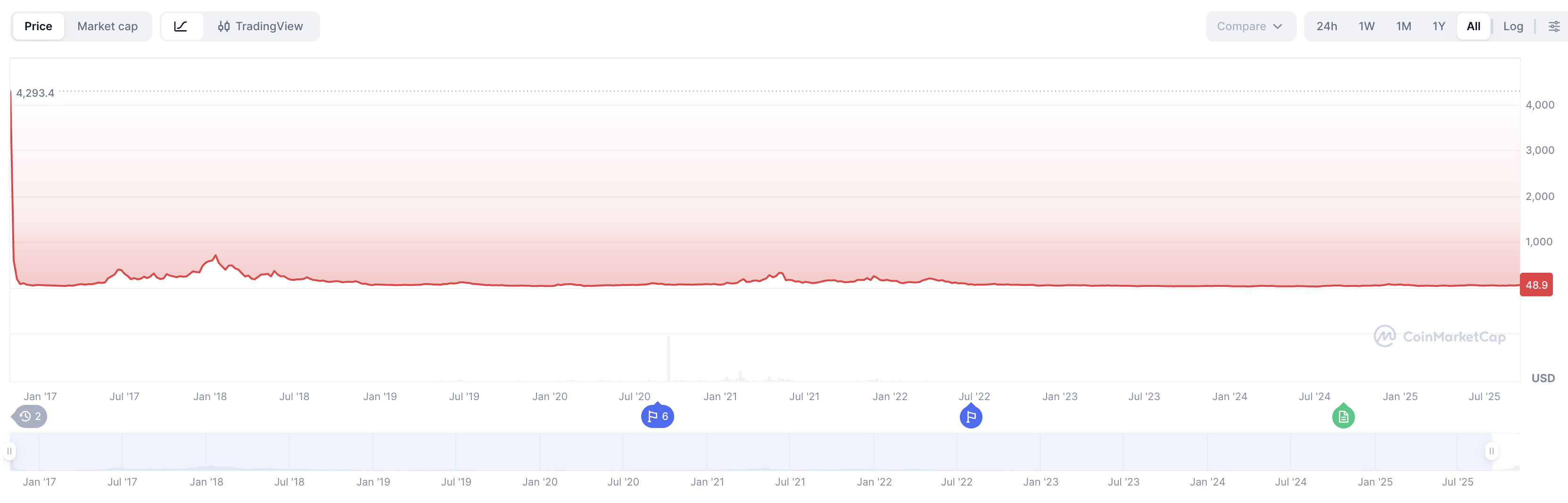
Until suddenly it didn’t:

Obviously something other than the past price action got people interested. A past ugly chart is not the end for a cryptoasset.
I believe true traction and growth in DTF usage is the way. If it’s really happening, I think the past price history will not stop people from joining us on our journey.
(9) Reserve being forgotten/passed over by the rest of crypto
Legit concern. Same as above, I think the way out is through real traction.
(10) Reserve leadership being unwilling to seek attention for the project
We are ready to seek attention for the project.
(11) Me being a bad leader / not caring / giving up / being corrupt etc.
I care, I have not given up, and I am not corrupt. In the end we’ll be able to judge whether I was a good leader. Until then you’re stuck with me, so let’s make friends and get shit done.
(12) How Reserve will beat out competition
Right now we need to get PMF ahead of the others. Nobody in the index sector really has it yet, much of the TVL is incentivized, Reserve included.
This relies on execution by ABC, but as I mentioned above I think the time is right for RSR holders to join in on the key engine of progress: we need to sell DTFs to our friends and family, or if we can’t or don’t want to, grapple with why that is and improve them until we want to and can because they are great products. This is something a broad community can do way better than a handful of people at a small company if we coordinate properly. Once we have PMF, broader mass marketing campaigns will be more effective than they are right now.
Over time, the roles of the companies and diversity of RSR holders involved will shift as we go through phases.
Overall, we need to collectively out-execute the competition on distribution, brand, marketing, decentralized governance, neutrality, and ethicality.
(13) Getting true product-market fit for Reserve DTFs
As I’ve stated this is my number one concern and priority above all else. True growth in organic usage solves many of the problems we’re talking about here and is the fundamental engine that powers the system. It brings in fees, brings in attention, shows us what to focus on, incentivizes more participation in governance, raises the stakes and forces thought on how to improve governance, brings in more DTF creators to create more DTFs and grows our brand and network effect, prompts more integrations and listings to improve distribution, likely does well for RSR and thus improves spirits and access to capital for the treasury, gets our name out there in crypto in a positive, refreshed light, and so on.
Not getting true product market fit does the opposite.
You may argue that XRP went the route of mooning first and figuring out the product later. They are still figuring out the product and may die a very painful death of failed product meme. It’s a morally treacherous position they are in and I hope they can figure it out, but I don’t think it’s the way.
I think the way is improving the core products and the brand, narrative and reach in lockstep, so we grow the movement and validate that it’s real at the same time.
Do you have something to add or debate? Did I miss something?
We are in step 2: discussing the concerns. Please discuss what I’ve put forward, point out where you think I’m wrong or missing something, and if you agree with me please express that so we can tell who is on the same page and who’s not.
Timing for next steps:
The announcement of the project ABC is working on is currently scheduled for next week and the ABC team is working with partners to make sure things are ready. Thomas said if we weren’t live by the 14th we’d start the conversation anyway, so I’m keeping that promise with this post, and once their announcement comes out that effort will be a background fact as part of this discussion. Please join me in cheering for Reserve on the day of the announcement, it will be an exciting DTF launch with new partners worthy of celebration!
We want to point to two powerful tools for community deliberation that we have used in the past that empower decision making well past what is possible on Discourse, a support forum software first and foremost that somehow found PMF in DAOs - mostly through first adopter precedence, instead of merit.
One is https://www.harmonica.chat/ a communal deliberation software. RnDAO use it to make investment decisions. Other decentralized teams use it to shorten the time to alignment by 10x and more. We know the founders and can triage support.
Another, which is still an alpha version at the moment is https://negationgame.com/.
Negation Game is a tool to make the implicit explicit and reason through pros and cons of a decision, uncover dependencies and ultimately understand the decision space communally.
There’s a futarchic market-based decision system called Carrol mechanisms on top, that is currently being developed. We know the founder well, and are confident they would jump on this opportunity with zest.
We love the newfound sense of urgency around governance design and experimentation and look forward to contribute to this process.
I’m open to trying other tools. Using something in alpha seems too risky for a discussion this heavy though.
Could you set up a Harmonica instance, perhaps with a small subset of the topics we have raised here, for us to test out and decide if we’ll go full-hog?
In the meantime, I encourage others to keep posting thoughts here in this thread.
Thank you Nevin for the thoughtful response. Sharing a few points to keep our work maximally productive. Since the list is lengthy, I’ve numbered here just to keep track myself.
-
The “ownership” pillar felt absent in your post. It’s the core of my RSR health proposal so I want to lead with this. My argument is stronger community ownership will enhance RSR health. Its more important than any other single issue imo. Recently, Thiel’s line circulating is a good reminder: “Without a stake in the system, they turn against it.”
-
Love the idea of one big beautiful bill to make RSR great again. Your steady engagement while handling daily ops things and juggling everything else is genuinely appreciated.
-
If farmers are dumping RSR this may be a nod toward they think its overvalued (re: FDV discussion), not worth holding onto. Good litmus test! I know a number of institutional investors that dump and others that hold or even buy more in ecosystems they care about. How can Reserve engage the latter, get them to the table to invest and build with us?
-
Appreciate you calling out the “Can’t be evil > don’t be evil” principle, twice. If somehow the result of this exercise moves us significantly into that direction, I see this as a big win.
-
I am a bit surprised to be credited so strongly with the Bitcoin curve idea now. The concept was discussed during Monetarium, but I had already resigned from ABC Labs weeks before Monetarium 1, so the attribution feels unexpected. To clarify, the Bitcoin curve was not my idea, but it did seem a better idea than its predecessor. So I would actually call that progress. And I agree with you, it was a good meme. We can treat the past year as a beta test that clarified the concept’s weaknesses. Again, progress!
-
I don’t think it was a mistake not hardcoding the emissions bitcoin curve. Sometimes the universe works in mysterious ways, and we are better for it. Also had it been hardcoded, it would not have addressed practically any of the issues raised in the RSR Health proposal. We dodged a bullet!
-
On Bitcoin transparency, adaptability and proof of work distribution. Anyone can look at who competed for, and performed the SHA256 puzzle work and who received the rewards. Its not one big monolithic number, its more like an index of activity that gives people something to talk about, something to compete for. That’s the transparency and proof of work distribution part. Thanks for flagging adaptability. I was referring to Bitcoin’s security but that term is a little misplaced here – my bad.
-
Imo, this statement is both true and problematic “The distaste for the Bitcoin analogy is, in my opinion, mostly downstream of people being unhappy about the price. If demand for RSR had grown this year and the price were up, people would be complementing us on the genius move to emulate Bitcoin.” This implies to me we might mask fundamental health issues with a seasonal speculative boom and things will be ok. We don’t have product market fit yet. There is very little new bid in the market. The boom we all want may not come, and if it does, how long before it ebbs? We cannot predict what the market will do in the future. I suggest we focus on things we do have control over, upstream changes can we make to improve fundamental health, today.
-
However we approach RSR emissions, I hope we can try to think in a first principles fashion of what we would create if we were starting over today. We are currently in a PvP market for attention, with less than 2% of earth transacting crypto on a monthly basis. 5 year old promises won’t matter to the future coming 98% who will have many ways to invest their attention and resources. They want the best of what is available today.
-
Is 100B RSR high, or low, or just right? Tbh, it feels like saying “XRP is going to $20 because it’s only $2 today.” On its own, how can anyone tell if 100B is good or bad? It’s a number without context, without performance. I believe we should be asking ourselves, compared to what? This is why investors look at value metrics like TVL/FDV or P/E ratios and compare them to other opportunities that seek their time and capital. I have advocated for TVL/FDV, but maybe there are better value ratios? What we know about the 100B is that one party controls a material share, and professional investors have flagged this concern for years.
-
I hear you on concerns about mintable RSR being unattractive. Still, it’s worth testing the idea with fresh institutional and activist capital to understand what would draw them into the ecosystem. Existing holders have endured a long grind and may not drive new momentum.
-
Agree a hard fork would be messy and cumbersome, but we’re already living in a messy situation. Counterpoint: marketing opportunity. It’s also an energizing storyline that draws attention and revives ecosystems. SKY and MetaDAO and others have leaned into it. I’m hearing privately that several other teams are exploring similar.
-
I think this is huge: “engage the whole community of RSR holders to personally introduce DTFs to their friends and family whenever they ask which crypto to buy, then report back on whether a DTF turned out to be the right fit for them or not.” Amen and agree!
-
Get that people are upset but we can’t control the RSR price from five years ago, or even today. We can control RSR’s health in today’s opportunity and competitive landscape. With 98 percent of the world still not using crypto monthly, we have a shot at getting Reserve into the global consideration set. I’d recommend we focus on what we have control over going forward.
-
On product-market fit for DTFs: can RSR accelerate it? Why or why not? I am arguing here for a cultural change that if RSR is woven more deeply into the story and Reserve’s edge, the conviction shows up everywhere. And if RSR isn’t the edge, we should get aligned on what is. I’m wrong plenty, but aligned clarity on Reserve’s edge would be something worth spreading with friends and family.
-
Realy excited for the next launch!
Thank you for considering.
Thank you Nevin for your transparent and detailed post. I appreciate this level of openness. It’s something we rarely see in other crypto projects and it deserves to be acknowledged.
Before I start: I’d like to get in touch with you on telegram, I’ve already sent you a message there. My username there is Veganiel. Thanks!
Personally, I feel the Reserve team is doing a very good job overall and I currently have no reason for concern. I’m confident that the decisions being made are carefully considered and in the best interest of the project, even though I can understand why some community members are worried or asking for more clarity.
From my perspective (and I agree completely with Nevin and the reserve team) the most important next step is continuing to build out the project and develop new partnerships. That’s what will strengthen both the ecosystem and the token in the long run. I really hope to see a lot of progress in that direction!
Transparency is important, absolutely, and as long as it’s honest transparency, I feel the project is moving in a good direction.
Something I personally would love to see is more updates about Ugly Cash and the broader Reserve ecosystem, not just protocol-level topics. I even ran a small poll in the Telegram community and the majority also expressed that they want more ecosystem-wide updates like growth of Ugly cash, which shows that this is something people genuinely care about.
Thanks to everyone here for the discussion. I hope we can continue finding the right balance between healthy critique and productive progress.
Nevin — this is one of the most candid and detailed founder posts I’ve seen in crypto. The transparency around mistakes, emissions decisions, treasury actions, and governance shortcomings is appreciated. But after sitting with this, I think the core issue isn’t any single parameter — it’s structural.
1. Goals are clear, but the dual-mission creates drift
You framed Reserve’s purpose as both making money and solving store-of-value/inflation. Those aren’t incompatible, but they do create space for narrative drift and fuzzy capital allocation. If RSR is going to work long-term, its economic engine must stand on its own — simple, predictable, and independent of mission language.
2. Confusion Capital functions as the de facto central bank
You openly acknowledged that CC controls emissions today, decides how they’re allocated, and that the system is trust-based until governance evolves. That honesty matters.
But this is the structural weakness everyone is circling:
-
No hard on-chain rules
-
No independent oversight
-
No constraints on future discretionary sales
-
No binding framework for capital allocation
Even if CC has acted responsibly, the system depends on continued benevolence. That’s not a durable architecture in a market that punishes uncertainty.
3. The BTC-shaped emission curve copied the pattern, not the cause
The emissions curve itself isn’t inherently wrong — but the justification abstracts away the real reasons Bitcoin’s curve worked:
-
Neutral distribution
-
No treasury
-
No discretionary emissions
-
No single entity capable of reallocating supply
Copying the curve without copying those fundamentals creates a mismatch between the analogy and the economics. The market reacted to that mismatch.
And this is the part that matters most:
Your emissions policy is a capital issuance policy. Treat it like issuing new stock in a public company. You wouldn’t say “we’ll just drip 8% of new equity per year because Apple feels good.” You’d tie issuance rigorously to returns on that capital.
An emissions curve shouldn’t be a meme reference — it should be tied directly to measurable economic value the protocol is generating.
4. Governance concentration is still the elephant in the room
The openness about ABC and other entities holding dominant voting weight is appreciated. But the system still functions like this:
-
Insiders can coordinate
-
Average stakers can’t counterbalance
-
“Decentralized governance” becomes symbolic
Until enforceable constraints or caps exist, the optics and the reality remain misaligned.
5. Community-led DTF distribution is premature
The plan to have RSR holders introduce DTFs to friends and family is well-intentioned, but it recruits retail as a salesforce before the product is frictionless, deeply liquid, and simple to underwrite. Community evangelism should follow — not precede — total clarity in UX, liquidity, volatility expectations, and long-term value.
6. What would actually restore confidence
This discussion makes one thing clear: the community doesn’t need new narratives — it needs hard guarantees.
Immediate improvements that would materially shift sentiment:
-
Hard-coded, rule-based emissions schedule
-
Simple, on-chain treasury allocation rules with quarterly reporting
-
Explicit constraints on how unlocked supply can be used
-
Governance decentralization through real caps or independent stewards
-
A one-page explanation of RSR’s long-term economic engine, free of analogies
These “boring” structures are exactly what create durable trust.
If emissions, governance, and capital allocation become rule-based, transparent, and non-discretionary, everything else becomes easier: adoption, narrative, trust, and eventually price.
Thank you Nevin, I do respect and admire your vision and transparency.
Appreciate the updates, however, I still personally don’t see transparency with the locked supply and its utility. Therefore, I won’t comment on other points but point 4 Fundamentally, if the Treasury has enough tokens to date and Reserve really cares about its $RSR token utility and value to shareholders and long term supporters. Then this “trust” you speak of will be there only if the 30-40B tokens are burnt. If we create a space for no “fall back” and create a “succeed at all costs” culture then I’m sure the Treasury of CC will be put to good use, remain frugal, and the community will support. As the $$ value of $RSR increases the overall ecosystem value will increase, along with participants etc.
Appreciate the transparency surrounding the “net buying” but that unfortunately doesn’t answer James’ fundamental question to the locked/emission supply problem.
Questions I’m keen to understand better:
How much of the 20B Treasury is there still?
What is the runway and utility of these tokens for the next 5 years?
What are the revenue generation activities of CC/ABC and how much of that is funding current OPEX?
The additional 20B odd that the team/contractors/etc have, I assume is covering wages, motivation to succeed, and ultimately the goal of “becoming a billionaire”.
If UglyCash is indeed self/privately funded, why aren’t they paying/buying for the $RSR tokens on public market that are being used for incentives on the platform?
Uglycash and Sentz were the growth drivers for eUSD, yet that doesn’t seem to have succeeded, why? eUSD has dropped in total minting, yet somehow Uglycash balances and activity is growing?
You worry about people not buying $RSR because the price will be high? What are we talking about here..Amazon, TSLA, Apple well over $100 a share and everyone still buys. Blackrock is valued at $160B, an equivalent Reserve valuation will be at $1.6 $RSR..LOL, I won’t say anything more.
Until I see data to prove otherwise, no project needs 100B tokens, unless they’re pump and dumps.
Please don’t bring XRP here, many won’t know this, XRP has company shares in the private market, I personally know a <10th employee. If Reserve has something similar we don’t know about, then it explains the lack of care for $RSR, although I don’t think that’s the case.
If Reserve is actually serious about $RSR community selling DTFs to their “friends and family”, then I’m sorry but you’re communicating that Reserve will fail to succeed with institutional adoption. No family and friends matches to institutional adoption and ensuring these channels unlocked and onboard, I hope the November 14th update is along these lines.
Anyway, as a long term RSR holder and community member, I’m not going to lie, first time in years, I am doubting the fiduciary responsibility of Reserve succeeding as a DeFi platform and an ecosystem for investors/shareholders to contribute to and derive value.
I do wish for Reserve to succeed and I’ll be here to support through thick and thin. Peace out
Thanks Nevin for once again bringing transparency to the community.
I have always showed my support and how much I trust you and the team. I have been accumulating RSR tokens for 5 years now. Never sold one. Recently I sold a big bag of FET due to my loss of trust in the Team and the Project. My decision was never due to the token price. I sold for a good profit still and allocated all in RSR. It’s all staked and I have no intention of selling any time soon but this recent conversations have me doubting about my decisions. Reserve has 7 years of existence and an amazing team and leader behind and it can not sustain a 1 cent price and it sits 200% of ATL. Why? What is wrong? Revolutionary product and technology. Amazing Team working tirelessly to make it happen.
Definitely there is no demand for RSR and CC sells 1B tokens at high price in 2024? I imagine the cost for running all company’s under the umbrella of CC are high and the capital is needed to keep the engine going but how can we attract new investors if today investors serve as liquidity providers to keep that engine going without any return?
Bitcoin has proved that there is no Crypto success without its community. It creates a cult behind who will support it no matter what happens. And right now Reserve has created and amazing product and a big company with little community support. The feeling I have everyone is just holding and waiting to dump it. I am here and I am not leaving. I hold RSR to zero and I will be ok I invested a good average apartment in terms of fiat if I have kept my money. I have been always a risk taker. More like a kamikaze. I just believe it. And money for me it’s a tool to buy my freedom. I really don’t care about possessions. One of the reasons I follow you it’s the family name you carry.
Reserve needs a big player as part of our cult. Our little community with ordinary people won’t do it. We have no argument at this point and we all look stupid.
At this point I will keep vibrating in a positive way hoping Reserve launches something massive to really make us believers proud for believing it this whole time. So many ups and downs. I can’t wait to prove the haters were wrong along the way spreading FUD and Hate about this beautiful project.
I hope to see not just the privileged people holding assets protecting their wealth against monetary scrutiny but the unbanked and unprivileged having the same right! Bring on DTF’s for life.
MAKE RSR Great!
Take us to the top 20 of Cryptos by MC. We will be seen.
Sincerely,
Fernando
Hi everyone —
I’m not part of the Reserve team. I’m a wage slave that has been consistently DCA’ing since 2021, staking since the earliest days, and living my entrepreneurial dreams vicariously through the Reserve team. They have my utmost respect - and I admire Nevin tremendously.
I’ve always admired Nevin’s willingness to make hard pivots, communicate transparently, and stay principled under pressure. In my view, he remains one of the most thoughtful and brave founders in the entire industry.
And despite market sentiment, I still believe Reserve is one of the most important projects in crypto.
1. To the Community: The Price Pain Is Real — but It Shouldn’t Dominate the Strategy
Yes, RSR’s price performance hurts. Many of us are deep in the red, and it’s emotionally exhausting.
But focusing the discussion primarily on the token price or emissions risks pulling us into a loop that doesn’t actually strengthen the protocol.
A quick note on emissions/burn:
-
Emissions are becoming more scarce — less RSR entering circulation each month means structural scarcity is steadily improving. And the protocol does include a burn mechanism via fee-flows and buy-backs.
-
That’s structurally positive.
-
But growth will come from demand, not supply tweaks.
If we want healthier price action later, today we need more adoption, more integrations, and more builders using Reserve rails.
That’s where the conversation should go.
2. To Nevin & the Team: Some Long-Held Assumptions May Need Re-Evaluation
The crypto landscape today looks very different from 2022 or 2023.
Regulation has shifted, institutions are openly embracing tokenization, and the industry now rewards visibility and integrations more than quiet building.
With that in mind, I think a few assumptions are worth revisiting:
A. “The community will build the ecosystem”
Builders need:
-
SDKs
-
starter templates
-
simple integration guides
-
sample apps
-
clear incentives
Right now, these are missing. For most developers, that’s a real barrier.
B. “Stay very low profile; avoid hype”
This made sense during past regulatory uncertainty.
But today the landscape is safer, clearer, and much more open to “building in the open,” especially with tokenized assets.
We don’t need hype — we need visible wins, integrations, and progress updates.
C. “Perfect the protocol internally before pushing the ecosystem”
The protocol is already exceptional engineering.
What’s missing now is ecosystem activation.
3. To the Community: Let’s Talk About Growth Opportunities Instead of Tokenomics Loops
If we want RSR demand to grow, we need usage of the protocol.
Here are practical, short-term growth vectors that I think Reserve could accelerate:
A. Developer Toolkits & Integration UX
-
A simple “Build with Reserve” SDK
-
One-click example integrations
-
Templates for wallets, payroll apps, remittance products, savings apps
This alone could unlock dozens of new builders.
B. More Real-World Integrations (Ugly Cash — but many more)
Examples:
-
A small exchange using eUSD instead of USDC
-
A payroll platform paying salaries in RTokens
-
Remittances settled through DTF baskets
-
Loyalty programs backed by diversified RTokens
These are realistic and powerful demand generators.
C. Institutional Partnerships
The Monetarium Dialogues already show Reserve is engaging at high levels, and there’s a real opportunity to turn that into deployments.
These could create meaningful, persistent balances on-chain—driving the fee flows and long-term demand that ultimately support RSR.
D. Ecosystem Incentives
Not inflationary farm-and-dump incentives — just reasonable alignment:
-
revenue sharing
-
integration fee reductions
-
co-marketing
-
builder grants and bounties
Give builders a reason to choose Reserve rails.
4. To Nevin Specifically: Your Signal Could Re-Align the Whole Community
Nevin, your detailed posts in this thread are deeply appreciated.
I think the community could also benefit greatly from one clear message from the core team:
“Here are our top 3 ecosystem-growth priorities for the next 90 days.”
Even small, pragmatic priorities would instantly shift sentiment from frustration to forward motion.
5. Final Thought: This Is the Moment for Growth — Not a Pity Party
We all feel the price pain. We all want RSR to thrive.
But Reserve’s long-term value is going to come from:
-
integrations
-
usage
-
fintech adoption
-
institutional adoption
-
developer tooling
-
ecosystem expansion
Not from debating burns or emissions for the next 12 pages.
Let’s focus our energy on what will actually strengthen the protocol and drive demand.
The mission is still critical, the engineering is world-class, and the opportunity is still enormous.
I’m here for the long haul — and I believe Reserve can absolutely win if we shift our focus to growth and ecosystem activation.
Happy to help however I can, including outlining a potential “builder activation strategy” if that would be useful.
Thank you again, Nevin & team, for your continued determination. You can do it. Never give up!
Before I offer some feedback on a number of the points raised, I figure it makes sense to introduce myself, or at least summarise my crypto / Reserve journey, as this is the first time I’ve contributed here and I believe a bit of context can help others understand where our positions may stem from.
I’ve been an RSR holder since summer 2020, having held BTC and XRP prior to their respective 2017 and 2018 tops. I currently hold a small amount of BTC in addition to my RSR bag. I was initially drawn to Reserve because of the Venezuela project. It seemed valuable, serious, and appeared to be moving in the right direction. At this time, RSR’s function was also clear, and just as importantly, could be easily explained to a large number of people. I also remember watching and reading some of your early social media output and being impressed by your anti-hype stance. This was a refreshing change from the behaviour one is often exposed to in the crypto space. Additionally, the idea of taking time with the mainnet launch and ensuring all the regulatory stuff was in order and the code was solid before making any serious noise resonated with me, as this is the way I like to operate within the context of my business operations (multiple venues across Spain and UK). Clearly, in the 21st century, many companies prefer to take a chance and cut corners in order to get to market as quickly as possible - many get away with it and some do not - but for me, when it comes to investing, I prefer to back companies that don’t cut corners.
My first concerns came a few months after the mainnet was safely launched, as there seemed to be no more intensity or enthusiasm in Reserve’s messaging, and as a result, it didn’t feel like any momentum was gathered. I voiced my concerns to you at the time over a series of messages, and having learned of my experience in business and as a marketeer, you seemed to take what I said on board, and I walked away from the contact assured that you had everything in hand.
Over the two years that followed, I regularly added to my bag, buying right down to the lows of around $0.002. During this time, I was very busy launching a new venue so I paid little attention to the protocol. As a result, I was not aware of the issues in Venezuela and the pivot that followed.
Fast-forward to 2024, my RSR bag had performed well and I traded up at the 0.027 highs, bagging myself another few million RSR. With hindsight, at this point I should have taken a deeper dive into the overall health of the Reserve project, and at least reminded myself of the dates in which tokens would start to be released from the slow wallet. I totally accept that you were transparent about this process and it was entirely my responsibility to revert back to the roadmap and check the details of the emissions.
As it stands, I regret not selling my entire bag last year, as its value was substantial. One year on, I find myself with unrealised losses for the first time since 2022. But unlike 2022, I find myself in a situation where I’m not confident enough in Reserve to start DCAing into this dip, and what I would like by the end of this period of mediation is for you or another member of the team or community to give me a reason or reasons why I should become confident in the Reserve project once again.
This brings us to the current day, so I’ll try to address a few of the points as I see them. That is, as a successful business owner and creative who got involved with Reserve because it looked like a decent, meaningful project with the potential for a 5 - 20x return on my investment over a number of years.
3. Since demand isn’t here as yet, it seems obvious that rethinking and swapping out the current emission rate to a hard-coded, rule-based emissions schedule will be beneficial in the short to medium term.
4. Let’s be real: 100 billion is a scary number. It is so large that most people cannot even begin to comprehend it. This was my feeling in 2017 when I bought some XRP, and was my feeling 3 years later when I bought my first 500k RSR. I still bought it though, and my feeling is that others will too if they are shown some reasons why they should!
6. *As I’m writing this I’ve just noticed the promo on X for the launch of the CMC20*
Although the idea of pitching DTF’s to friends and family may sound pretty ‘small time’ and limited to many, in essence I believe it to be a good idea. However, I do have a number of concerns:
Firstly, I don’t hold any DTF’s myself. As someone who has been an RSR holder for 5 years, why don’t I? And yes, I want you to consider this question**.**
Clearly I can rectify this easily by buying a DTF, but if I were asked about crypto by a friend right this second, I would have to answer,
‘No, but I’ve held RSR, the governance token for the Reserve protocol on which the DTF’s are built’.
The likelihood is at that point, given the fact that my friend considers my opinion to be valuable (they’ve come to me for financial tips after all), they would say something like,
‘Well, why don’t I just buy RSR like you have?’
Again, please consider how I could respond to a friend or family member here. And what if they decide they do want to buy RSR?
Should I dissuade them? It seems counter intuitive to do so, but arguably some of your messaging in the past has been dissuasive.
Please also consider that a large number of the RSR holders who are deep in the red will be fatigued, angry, and will have limited patience and understanding, and are far more likely to favour people buying RSR than DTF’s, as they will see it as the quicker route to a breakeven and their investment back.
‘Why isn’t RSR baked into all of the DTF’s built on the Reserve?’
At this moment in time, I wouldn’t be able to answer that confidently. Remember, not everybody is immersed in the world of crypto and for most people looking to invest in a simple financial product, this is a reasonable question.
‘Why don’t I just buy Bitcoin?’
Again, I’m not entirely sure what my answer to this would be at the moment. Using the CMC20 Index DTF, since it has just launched: without looking at the data, I have no idea whether I’d have been better off holding the top 20 coins at the ratios shown currently for the past 12 months, or just holding Bitcoin. I’d like to think you know the answer, and obviously it isn’t difficult to figure out, but logic tells me there wouldn’t be much in it, particularly given many of the recent entrants, namely ZEC, HYPE, and LEO, did much of their pumping prior to getting into the top 20, as others, SUI, HBAR have dropped down.
‘I’ve looked at their website and social media and I don’t understand any of it?’
The reality is, if you are serious about regular people buying DTF’s then the shop window needs to change. It may come as a surprise to some of you, but most people don’t know what ‘on-chain’ means! Nor do most of them care. Indeed, for a lot of people, many of the concepts and processes you guys discuss are out of their scope of understanding, so if you are serious about DTF’s becoming a mainstream financial instrument you’ve got to make it easy for them. At the moment it isn’t.
In order to entice regular people to buy DTF’s, you must provide bigger, better and more consistent messaging, and an uncomplicated (foolproof doesn’t exist sadly), jargon free customer journey.
8. When you say ‘new entrants to Reserve’, what do you actually mean?
More developers building on the rails, or more people buying RSR, or both?
My feeling is that you mean both, but given most of the optics you’ve pointed out are more likely to put off crypto speculators than devs, I’m going to deal with the RSR issue, so please tell me:
‘Do you want people to buy RSR or not?’
It seems like such a bizarre question to ask the cofounder of a company that is funded primarily by the sale of RSR, but I think you will understand why I asked the question. Given that surely the answer is yes, you do want people to buy RSR, your messaging must attest to that. At the moment it’s confusing and gives mixed signals. To reiterate, I understand why you do this. When I found Reverse, I took your reluctance to push RSR as a sign of your honesty and integrity. But that was in 2020, not long into the project. With 2026 rapidly approaching, now is the time for certainty and confident, concise messaging.
Whilst I agree that as it stands, DTF usage is the best way for the RSR price to increase and be less open to such large fluctuations, at the current juncture I believe there is value in pushing RSR itself. At the bare minimum, there should be some mention of it on your social media bio’s, and frankly, I can understand why RSR holders are angered by its absence in these spaces.
To summarise the final points and close:
I don’t think you are a bad leader and I certainly don’t think you are corrupt. Leading a project of this magnitude is a huge undertaking and on the most part you have been impressive.
For me, other than a slowing down of the emission rate, the issues are down to marketing. Since Reserve is looking to reach a number of different entities, the marketing must be divided up. For example:
-
TikTok & Instagram - focussing on driving DTF’s to regular people through high quality vertical video that cuts out the tech jargon and makes things simple
-
X / CMC / Exchanges / Telegram etc - reaching crypto speculators to reignite some interest in RSR. A surge in the RSR price will surely get more eyes on Reserve more broadly
-
X / Website / Events - developers and future partners can be communicated with here.
Why would a developer choose to build on Reserve over a competitor currently? Do we have adequate incentives in place and do they have everything they need?
Finally, please reconsider associating Reserve / RSR holders with cockroaches. This is far from harmless fun and could be really damaging.
I look foward to seeing some progress over the coming months, and good luck with the CMC20 launch … I guess I should buy the dip!
I consider myself just an investor. I’m not really crypto & blockchain savvy. I understand how it works on a basic to intermediary level depending on topic, and wish I had the time to learn more.
Like many people I am down significantly, but appreciate the team’s and other knowledgeable people’s efforts trying to turn things around. What attracted me to Reserve years ago was the product to offer a safer collateralized stablecoin that people can use, especially in countries with hyperinflation, while RSR holders can also earn from arbitrage. It was simple. It made sense. It helped people.
I don’t recall the legal details, but that ended, and later DTF was introduced as memes. I was a bit shocked at first because memes are basically gambling with pump and dumps, but then slowly clicked that DTF can be used to index other cryptos after more research. Not sure why that wasn’t introduced as a crypto ETF in a different manner, but in any case, I believe there is first mover advantage here too.
The recent CoinMarketCap announcement was exciting. Except when you go to the CMC site and view the CMC20 index button at the top, which I believe was always there, it becomes disappointing. There is no indication that it can now be bought, not even when you open that page. In the FAQ, it says “We are actively collaborating with various exchanges, platforms, and counterparties to explore the possibility of creating investable products based on this index.” Well? Wouldn’t it benefit both parties if they promote it on their site, permanently?
Lastly, like the poster above mentioned, things need to be simple. Obviously there are geniuses working for and with Reserve, but it’s information overload. Diversified DTFs can be a fantastic way for people to get introduced to crypto and invest in it. I’d imagine advanced users with the cash and time can set up a portfolio themselves. Others may have the option to just buy an ETF tracking crypto in a brokerage account.
If DTFs are vital for RSR to succeed, why not create a simple, awesome yet professional website and app that allows people to purchase an Official Reserve DTF as the default with options for others and promote that heavily. The site can include visually appealing charts, and an area to learn more about crypto. OG Reserve was an introduction to crypto for many people in Venezuela, right? If Reserve cannot do it legally, maybe some partner can. This will also make it easier to suggest others to look into DTFs… I have no family or friends who are interested in crypto, and even if I did, where would I send them? Reserve’s site and app is for advanced users.
Hey @nevin.freeman,
Hope you’re well. Given the state of the market, it’s good to see the CMC20 pick up a bit of traction. With both this and the quote above in mind, I just want to draw your attention to Reserve’s X post linked below.
htts://x.com/reserveprotocol/status/1991657839564320904
While the post clearly has some merit, there is not one mention of RSR in the entire 8 ‘tweet’ long thread - even in the second section where governance is referenced!
Essentially, if somebody new stumbled upon Reserve’s X profile (Reserve’s preferred social media platform and the only one where there is any sort of following) they would need to click the linktree and make their way down to the 8th (penultimate) link just to find out RSR even exists.
I understand this is a promotional / explainer type post for the CMC20, and I am on the same page in that I know DTF’s need to be a success in order for the price of RSR to increase in a sustainable manner, but I still see no reason for RSR not to be mentioned in a post of this type on X. If it was a vertical ad on Instagram or Tiktok then of course, you make everything as simple as possible, but this was not that. In your post last week you mention the ‘many issues with optics’ - I’d suggest RSR’s continued ommision from Reserve’s own communication is a glaring one, and I imagine I’m not alone in this thinking.
I look forward to you addressing this and some of the other points raised by myself and other members of the community soon.
Enjoy your weekend.
Thanks Nevin for your thoughtful answer.
You said it’s on us as a project to grow demand faster than supply. What do you think the reasons were that demand did not grow faster than supply? Is it the broad altcoin market? In decline since 2021 and no signs of getting better. If we’re in a bear market I don’t see demand growing. If that’s the case what do you do with the supply? Keep releasing it into no demand and depress the price even further? What has the project done to grow demand of RSR? Like specific examples. Do you want people to buy RSR or DTF’s? Or preferably both? There is hardly ANY mention of RSR by yourself or the team. That rubs a lot RSR holders the wrong way. If the team is ready to go mainstream with a superior product then RSR needs to be talked about a lot more. The heart and soul of the ecosystem that nobody knows about or what it can do (stake, governance rights,vote-locking)
Optics: a lot of websites and exchanges when you click on info about RSR it still has outdated info about RSV. Even coinmarketcap. The CMC20 DTF creator! How is that still possible? It looks amateurish. Such a significant launch and still outdated info on the token. If a curious investor wants to buy the CMC20 and does some info on the RSR token he will be confused as hell.
A new investor will look at the price, chart and supply. Obviously RSR doesn’t have the best looking chart out there and that’s putting it lightly. So why would a new investor buy RSR? Or why should a long term holder keep buying RSR? If you would’ve told me 5 years ago I could’ve bought RSR for these prices I would’ve jumped on it in a heartbeat. But now I’m reluctant. We’re close to the bear market low and Huobi 2nd round seed. The supply IS a big concern when there is no demand. Hard coding it when certain milestones are not reached seems like a good option.
I agree that I think burning the supply does more harm than good in the long term but we need to see some metrics from the team how that money is used to increase DTF value and God willing an increase in RSR price. It seems like all the chips are on getting PMF for DTF’s. Who is the target demographic for DTF’s? Different marketing tactics needed for different demographics. Also why DTF’s? For someone who is not crypto savvy. Would he drop 50k on a DTF with the same peace of mind as he would in an ETF?
It feels like we’re at a crossroads. DTF’s get PMF or the project goes the way of the rest of the pump and dump altcoins. We as a community are willing too help any way we can. One day we’re rangers, the next day we’re rigatoni’s and now we’re cockroaches. This is all too confusing. We need clear directions, transparency and a vision we all can get behind. We all want Reserve to succeed, for your bags, our bags and mental health of the community.
Thanks again for taking your time to answer. I believe you’re a good person and you and the team are doing everything you can to make the project a success. We as RSR holders can’t see the BTS work you are doing but I’m sure there is a lot of blood, sweat and tears. I was reluctant to buy some RSR but if the price drops a little bit more I’ll drop some of my last money into the project for the culture. Let’s fucking go and get that mula baby 
DTFs are great but Reserve was created to combat inflation. What the goal with the reserve currency plan? Are we evaluating an anti-inflationary basket of goods that is backed against a token I.e yield/stable token?
Electronic USD $eUSD has gone pretty much nowhere and likely will be lost in the background against USDC or USDT etc.
We look forward to the team’s updates against the initial proposal by James above and the ideas, suggestions by the folks on the thread. Response/action plan timeline on the proposal would be great to see
Defeating inflation remains Reserve’s north star. Per the Reserve.org home page, the strategy is:
- Index all of crypto (generate adoption for DTFs)
- Index the world (add RWAs to indexes as they come onchain)
- Create an asset-backed world reserve currency (Index everything and defeat inflation)
If you want to learn more about what the research team is working on, you can watch their presentation at Monetarium 2:
