[RFC] RSR Health: Request For Comments

Was this super secret project the CMC20? I would hope that the entire ABC Labs team is not needed for 7 months for a single DTF launch.

Many OG community members have already lost faith in this project, and it’s partly due to the constant lack of follow through from ABC Labs. As CEO, Thomas sets the example, and we hope for better.

Happy Thanksgiving everyone.

8 Likes

To be fair @Braden, landing an institutional partnership in 7 months is quite fast. Flagging this because I keep hearing versions of “let’s just email some CEOs” as if that magically puts RTokens or DTFs on their apps. No, thats not how it works.

In the real world, institutional BD needs:

  • A vibrant brand people feel proud to share with their friends
  • A product differentiation/edge that outshines alternatives
  • Hundreds of hours of outreach, negotiation, and re-working the pitch
  • Long-term trust building before a deal can even be considered
  • Enough funding and cohesive shared ownership to make the above possible
  • A lot of luck

There are few exceptions where the above can be accelerated, and we ought to try, and equally important we should stack the deck toward our best chances of success (capital, talent, community, tokenomics, etc. = “health”) , but it really is hard out there, hence why >90% of projects go to zero.

CMC20 is a great step forward.

Onward and upward.

4 Likes

To be fair, Reserve is a 6 year old project so here is to that. What has been achieved so far ? Both DTFs LCAP AND CMC20 are not having any traction so far ( LCAP been around for 2 month and FDV is still 5.5 million, same as per original launch) CMC20 also no growth since inception. ETH+ got over 30K ETH pulled out of the system, dramatically reducing FDV of Reserve ecosystem. eUSD went no where, Peter Theil launching his own stable coin and not using Reserve protocol. The whole concept of fighting inflation got shattered as per how can you position yourself as doing so but at the same time inflating the Token of your own project thus doing the same thing you are trying to fight! The ABC labs been working for 7 month on this two DTF launches and we are total of 11 million in FDV that’s poor performance. You need 100s of million if not BILLIONs in DTFs to start even being attractive to serious investors. That’s my 2c

6 Likes

Many people are concerned CMC20 will go the way of the Bloomberg or CoinDesk indices.

What is different about this index? Is listaDAO an institutional partner? I’m not getting it. CoinMarketCap didn’t launch the index.

Thomas my offer to do those Spaces is still on the table.

4 Likes

Are we getting a formal response and action plan to the proposed direction by James here or is this a useless contribution from the Reserve community and we should instead just sell our $RSR tokens and walk away from a project that is so arrogant to acknowledge its lack of transparency and accountability for its shareholders.

4 Likes

Hey @nevin.freeman and everyone.

You’ve heard me throughout this proposal discourse talk about the importance of ownership. It’s a core tenant of web3, where users own the network.

Ownership can emerge in a variety of ways:

  • Stage 1 - Transparency - “I can see the raw facts without spin and form my own view.”
  • Stage 2 - Open collaboration - “I can coordinate with others to interpret those facts and contribute where it matters.”
  • Stage 3 - Governance - “My vote shapes what we do with those facts.”

Since some of this RSR Health discussion stems from conversations about how Bitcoin emissions work, I think its helpful to clarify in Bitcoin, every user has equal access to Stages 1 and 2 because the ecosystem is decentralized onchain. Stage 3 emerges from a subgroup of miners, pools and nodes.

This RSR health proposal highlights Reserve issues across all three stages. We don’t need perfection, but can we aim higher? Should we over or under index web3 values compared to our peer set? What do we even mean when we talk about web3 values? Answers to these questions are a cultural choice determined by the current center of gravity in the Reserve ecosystem - and its self reinforcing.

When users “feel” ownership, they invest toward a project’s success. When they don’t, they might undermine it, which we see in parts of this forum post’s comments and across global politics today. This is how communities can become compounding capital, either positive or negative.

I don’t expect everyone here to care about ownership. Many just want number go up, and care about little else. But there is a strong contingent of nascent talent in the Reserve community waiting to be fully included and to bring their superpowers accordingly. The [Initiative] Decentralized Ranger Folio (DRF) is trying to incubate that energy toward action, transparency, and positive-sum coordination for the community rather than slipping into further resentment and stagnation. Strengthening Stages 1, 2, and 3 of Reserve ownership will shape whether the DRF thrives (or other external initiatives/contributors) and becomes a helpful force in the ecosystem.

Below is a comparison table unpacking differences in Stage 1, 2, and 3 ownership across Bitcoin, Circle, Aave, and Alchemix. I’m sharing it so the people who care about ownership and compounding our capital can reflect on these market examples and consider what might be appropriate upgrades in the Reserve ecosystem.

Category Bitcoin Circle Aave Alchemix
Approach Decentralized. Emergent consensus governance by nodes and miners. Public company, GAAP accounting. DAO. DAO.
Reporting frequency By block, ~10 minutes. Quarterly. By block, ~12 seconds. Raw data and stats by block, ~12 seconds. PDF report quarterly.
Revenue n/a GAAP accounting in 10K & S-1. Reporting by chain, type, SVR, frontier staking. Reporting by asset.
Reserves (yield) return rates n/a Reported in 10K & S-1. Yes. Yes.
Expenses (strategy execution / funding) Managed independently by ecosystem contributors. GAAP accounting in 10K & S-1. By service provider and initiative (see governance forums). By category (see governance forums).
Token emissions / inflation Onchain, immutable 21M unless forked. Block rewards visible onchain. n/a DAO sets emission rewards and distribution via parameter updates; includes buybacks. Onchain unless forked. DAO can redirect emissions.
Treasury management n/a GAAP accounting in 10K & S-1. Treasury composition & returns; DAO-approved. Treasury structure & returns; DAO-approved.
Governance proposals, turnout, vote distribution BIPs on GitHub; mailing lists & IRC/Matrix. Emergent consensus. n/a Aave forums UI or BGD Labs voting UI. Alchemix forums & Snapshot.
Strategy & partnerships discussion Distributed across contributors, forums, social media, mailing lists. Reported in 10K & S-1. Distributed; consolidation coming via TokenLogic v2 in Q1 2026. PDF + ecosystem contributors.
Link 1 Mempool block rewards Q3 2025 Filing Aave - TokenLogic Alchemix Reports
Link 2 S1 2025 Filing Alchemix Stats

Be sure to check out the links. Thank you for considering.

2 Likes

Clarification: shared economics participation is also an ownership tenant of web3. Left it out of the above post for the sake of focus, but happy to add it should there be appetite to do so.

Hey @nevin.freeman,

Reading this thread today, it seems there have been plenty of good quality contributions made by the community, so I’m wondering if you have an idea when you will be following up on the points raised?

Warmest

3 Likes
  • 4,7 millions Rsr burn this month
  • +600 millions Rsr unlocked this month

That like a 14k dollar burn and near 2 Millions dollars unlocked

No problem here for the team of course, but for the non team believers, all are at loss, but do the team really care ? Nearly all long term investors on this token is at loss, the price today is same as it was when the token was only listed on huobi in 2020 !! Even if you bought Rsr in 2020 on huobi when barely nobody knew about Rsr and thinked « long term » like nevin tweeted once, you are at loss today, 6 years later

This emission curve similar as bitcoin is a total joke , and you lost most of the believers in this projet , but you dont care because you make money anyway Dumping absurd amount of tokens each month

The chart dont lie , long term investors all rekt, and You still dump 2 millions dollars Rsr by month , of course no problem for you and the team

An ex believer since 2019 who fall for the false promise of this project , a person who lost the battle of inflation investing in a project who fight inflation ,investing in debut 2020 when barely nobody knew Rsr , not Even listed on binance and all major exchange

3 Likes

I’m old enough to remember the internet going from 0 to 1. Odysseys were written in that era, winners, losers, surprises. Mountains that were molehills and speed bumps that were deadly.

My only aim over a decade (2020-2030) is to cut through the noise and find things that look obvious in hindsight. There’s probably 7 or 10 good crypto projects that could hit that. I’m checking my biases constantly and Reserve is still my “pipeline” choice.

But as James is battling for, on every ultra-marathon you do a trainers / health / nutrition check-in every few miles or so.

60M a year burned versus 6BN unlocked (even if not sold) kinda makes it hard to sell to friends and family.

I sometimes bounce around so many ideas that could “fix this”.

Burn 30 billion - the advantage instantly is that every event on Reserve brings value to each single RSR. Every Index DTF mint accrues value. And we might as well stake on a Yield DTF for APY in the meantime.

Team burns 1 RSR for every 1 RSR they unlock - would probably settle sentiment and lead to a large, ever-decreasing total supply. For the team, will also gradually grow the $$$ of a treasury.

Go veRSR - probably the smartest idea, it personally doesn’t sing to me in the same way as a fixed supply.

Continue as is - kills narrative and actual ROI / ROR. Maybe that doesn’t matter if you don’t have skin in the game, and want to see Reserve succeed at all costs without being a holder. But it gives the perception of “team dump” and kills the momentum which gives a headwind in crypto.

Truth is, I don’t know the answer, but there’s some thoughts.

For the record, I don’t love burns: 100bn supply is a good number if Reserve succeeds. It gives everyone a chance to own RSR at a low price and take lots of positions across different forms of money, rather than needing sub-divisions of an individual RSR to “stake on eUSD, govern on CMC”.

You can “own 500,000 RSR and then decide how each one work for you wherever you choose to place it; make fractional decisions”.

But surviving early growth is essential, and right now inflation (even if it’s narrative rather than reality) could be the killer.

Alternative options:

  • Unlock all RSR now, and then sink or swim based on TVL growth (doesn’t remove the “team holds all the governance power”, but is a step in the right direction)

  • A 50 year release runway for a Foundation would also work - danger is you lock operational costs into a past decision.

… Or a silly idea, put 30BN into an account, “Nevin’s account”, that is time-locked to an inspectable 1BN release once a year. Choose each year where you want to place it - everything from give it to Reserve, to burn it, to give it away, to make people compete for it with the best idea, even keep it.

Either way, inflation drops to negligible, you’ve earned our trust, and you get to make a new decision each year. And a beneficial dictator - but still a ringfenced, accountable, altruistic one - isn’t a terrible thing.

6 Likes

@0xJMG I hadn’t seen the Alchemix reports / stats before… Thanks for sharing!

1 Like

I’ve just posted a new RFC specifically focused on the governance part, as I think this deserves a dedicated forum post: Happy to hear your thoughts on this: [RFC] veRSR + Reserve Fund - Turning RSR into a True Long-Term Alignment Token

1 Like

FWIW @starl3xx I’d suggest the Aave/TokenLogic 4 tabs (highlighted) are present day state of the art transparency for an ecosystem with different contributors, roles, work streams.

Alchemix is solid but not very real time and a bit of a data “dump” without filtering context. Nonetheless Alchemix is a solid B+ in web3.
Aave = A.

1 Like

Thank you @0xJMG for putting the work in to draft the original proposal, your ongoing input and for kicking off a discussion which pales in depth to any other forum post I’ve seen. The amount of accounts specifically created to join this discussion is truly commendable.

While the comments contain some genuinely healthy debate and I am glad to see the team’s engagement (especially Nevin’s contributions), I am disappointed to see a handful of negative comments regarding the team and their output over the past 6 to 12 months. Firstly, I want to echo JMG’s point that the CMC20 is a huge step forward and represents a major achievement. We only see the surface of what was likely an enormous body of work to secure a flagship DTF partner, and having it presented above the fold on a site with close to 100m monthly visitors is something the entire ecosystem should celebrate wholeheartedly.

That said, the RSR Health discussion highlights several large issues. The most concerning for me is how RSR and its holders have become increasingly peripheral as the index protocol has grown. If we stay on the current trajectory, we risk creating structural problems that will be extremely difficult to unwind later, regardless of how strong the technology or distribution channels become. Below i’ve outlined my asterisks and caveats and after will move on to what I think a healthier future looks like for Reserve.

Centralised Governance Power

  • It is unclear what stake ABC Labs and CC have on each DTF and how much is delegated.

  • Proposals often pass with 3 to 6 governors, with little independent participation.

  • Concentrated and opaque voting power discourages community involvement, reduces decentralisation, and limits DTF resilience.

Poorly Structured Governance Flows

  • LCAP governors currently vote on basket rebalances before the benchmark is published by CFB.

  • This requires trust in third parties instead of independently verifiable information.

  • Despite this unconventional setup, there has been no formal education on how governors are expected to evaluate these rebalances. This is especially surprising given the LCAP vlRSR airdrop was designed to encourage wider participation.

RSR Burns

  • Although RSR burns are popular among the community, they are not celebrated, scheduled, or documented in a consistent way.

  • Current opacity creates unnecessary uncertainty and invites FUD at a time when burns could be a source of positive sentiment.

Fixed Platform Shares

  • The original plan for index DTFs was a 50 percent platform share that would gradually reduce as TVL milestones were hit. LCAP followed this, but CMC20 launched with a 33 percent share, a 35% reduction, with no conversation around if this will remain fixed or reduce as TVL milestones are hit.

  • The issue is not the change itself, adjustments are normal in a developing ecosystem. The issue is that changes to the core value accrual mechanism for RSR were not clearly surfaced to the community.

  • Without PMF and strong distribution, value accrual will naturally be limited for now, but clarity and predictability remains important for long-term holders and potential investors.

eUSD Mandate and Revenue Share Programme

The initial eUSD revenue share model served its purpose by establishing early traction, helping fintechs grow, and introducing a yield structure familiar from Web2. However, the current programme has several weaknesses that have not been addressed quickly or transparently.

  • Mandate clarity: The current mandate covers only basic stablecoin requirements. With no clear guidance on risk parameters, yield benchmarks, or over-collateralisation targets, the DTF is difficult to govern.

  • Fintech needs: Compounding the point above it is also difficult to govern without fintechs clearly communicating their preferences. For example, basket change proposal 5 concentrates more than 60 percent into RLUSD, but we do not know whether fintechs prefer diversification or concentration. This needs to be clarified before we can effectively govern.

  • Fintech Transparency: UC and Sentz have recently begun sharing quarterly updates, which is a positive step. However, it is unclear whether this cadence will continue consistently.

  • Over-collateralisation: UC has grown rapidly, increasing its eUSD balance from $4.3m to $6.4m last quarter. Without changes, continued fintech growth reduces over-collateralisation over time. There has been no public discussion on ideal over-collateralisation levels or the path forward once these thresholds are approached. I’d prefer a pro-active discussion on this rather than making the wrong decision reactively further down the line.

  • Governor Fatigue and Centralisation: I know this point has been hashed and rehashed on both the forums and during GovOp calls but I still think it’s worth discussing. The core argument against centres around ‘quorum is always reached so this isn’t really an issue’ but when governance is so centralised with 4-5 wallets voting on Revenue Share ratification votes which almost never contain a completely independent participant it’s a mute point. Independent community voters are fatigued or were never engaged and only institutional or incentivised participants remain.

  • Value accrual to eUSD stakers: Fintechs currently receive the benefits of governance and over-collateralisation for free. Although the 100 percent revenue share model made sense early on, there needs to be a roadmap that gradually balances value between fintechs and RSR stakers as fintechs mature.

Until these issues are resolved, eUSD remains an asset with limited transparency, centralised governance, growing operational complexity, and weak alignment with long-term value accrual for RSR. Once fixed, I believe eUSD can scale much further and onboard additional partners.

Siloed Index DTF Governance

We’ve now seen some of the market’s strongest ecosystem participants (CMC / Binance and Kraken / CFB) and VC and PE firms such as Venionaire Capital create index DTFs which in lieu of creating their own governance token have chosen RSR instead.

This approach is clearly a win-win: it allows DTF curators to avoid the operational overheads and legal exposure of creating a token, while also introducing another RSR sink that benefits the broader ecosystem. However, under the current structure there remains a significant disconnect with Reserve’s pre-existing network, as participants who want to co-own and contribute to a DTF still face a high barrier to action, one that only grows as more DTFs adopt RSR as their governance token, increasing choice and inadvertently amplifying decision paralysis. There is almost certainly a better way for DTF curators to tap into these existing network effects and engage hundreds of enthusiastic RSR holders, promoters, and governors from day one and shorten the Reserve’s ecosystem user funnel.

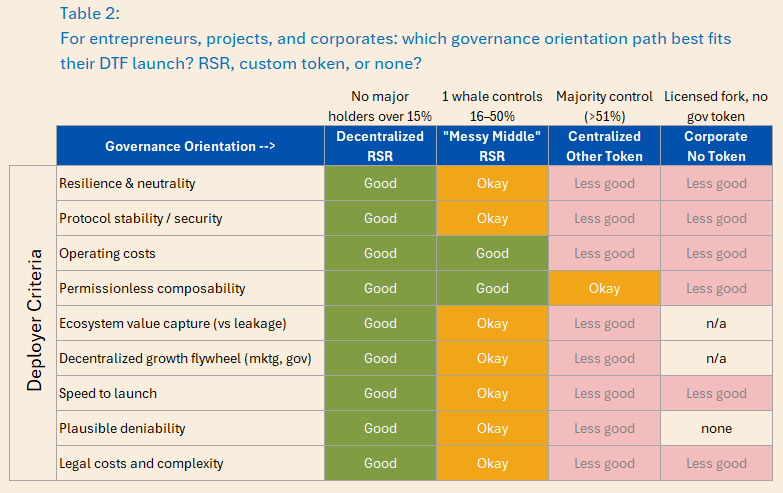
@0xJMG table on DTF governance orientation comes to mind here…

Education around new DTFs

  • The lack of structured education and onboarding during new DTF launches results in minimal co-ownership and limited understanding of who the DTFs curators are and what their index methodology is, $VLONE is a good example of this.

  • The RSR community is small compared to the broader distribution channels available to DTFs, but it remains a simple and predictable early adoption funnel.

  • The low governance participation and minimal activation for LCAP and CMC20 holders indicates that education and engagement efforts need improvement.


Taken on their own, many of the points raised above could be viewed as small weaknesses in an otherwise strong and forward-moving protocol. Looked at together, however, they highlight a direction that should concern anyone who wants RSR and its community to remain central to the ecosystem. If these issues are not addressed, we risk sliding toward a setup where governance becomes more centralised, governance decisions become harder for independent participants to influence, and the token’s core value accrual mechanism remains undefined. That kind of environment will continue to dissuade current governors, not attract new governors and also risks pushing existing community members further to the sidelines, increasing their bias to action.

The encouraging part is that this is fixable. The level of engagement in this thread shows that the community is aligned on wanting better structures, clearer incentives, and a healthier position for RSR within the protocol. By improving transparency around governance power, formalising value accrual expectations, tightening operational processes, and giving RSR holders a clearer path into new DTFs from day one, we can strengthen the ecosystem meaningfully. The technology is strong and distribution is improving. The next step is ensuring that governance, incentives, and participation are set up in a way that keeps RSR and its community at the centre rather than at the edge. If we do that, we build a protocol that can scale while staying true to the principles that made people want to co-own it in the first place.


The Path Forward

The path forward is undoubtedly long and will include many twists and turns before we arrive at a protocol that the majority are happy with but if a focus is placed on reinstating RSR and its holders as a core pillar of the ecosystem significant gains can be made, creating a much more fertile, engaged and educated ecosystem that people will be proud to be a part of.

While there are no quick fixes to address the concerns that arise once my asterisks and caveats are taken as a whole I do believe there is some actions that can be taken relatively quickly (first half of the year) which will have a significant short-term positive impact on co-ownership, decentralisation, governance and community participation. These actions include;

Unification of siloed index DTF governance and staking rewards

  • Bringing all the governance and staking rewards for all index DTF vlRSR positions benefits DTF curators as it reduced current frictions preventing them from tapping into Reserve’s pre-existing network of active participants and benefits the ecosystems active participants as they now have a central hub through which they can govern and receive revenue from index DTFs in a single click.
  • It’s yet to be determined but JMGs suggestion for a veRSR model could work very well here with participants opting to max lock their RSR benefiting from the largest pro-rata share of voting power and index DTF revenue.
  • In my mind it does not make sense for RSR staked on the DTFs built on the yield protocol to be included in this model given the additional slashing risk.
  • Once an established and mature governance model has been built the model could begin to transcend index DTF governance and include protocol wide governance in its scope, e.g The burning of 30b RSR that is currently held in the teams treasury. However, if this route was chosen a weight would have to be determined for RSR staked on the Yield Protocol. Since the unlock duration is 2 weeks on the yield protocol the voting power of RSR on the yield protocol could be weighted equally with RSR under the new veRSR model employed in the index protocol.

Increased Transparency around ABC Labs / CC voting power

  • ABC Labs and CC to increase transparency around their total stake on each DTF
  • Stake RSR from a single address that is tagged with an ENS domain where possible (the Index Protocol doesn’t appear to support ENS Domains at present)
  • Consider guidelines to prevent concentrating voting power between the core teams e.g a percentage of the total voting power for each DTF
  • Quarterly self-reporting on voting power concentration including the amount of RSR staked on each DTF, which wallets contain the stake, the increase or decrease in stake over the quarter and the amount of RSR delegated. The forums could easily support this self-reporting.

Education and Incentive Programme to support Community Delegates

  • While the above point suggests limiting both core teams’ stake to a percentage of total voting power, this does not limit the amount of RSR that can be staked on a DTF as it can be offloaded to other delegates.
  • Currently to the best of my knowledge there are only three delegates in the ecosystem; myself, Sawyer and StakeDAO. However, three is inadequate to support decentralised governance. In order to support decentralised governance and to distribute the teams stake we need more delegates.
  • I’ve recently read an after action report by StableLabs who conducted an education programme to increase the number of Scroll delegates and think something similar could be employed by Reserve, increasing the quality and community participation in governance through education. The graduates of this programme were rewarded a cash prize based on their final rank. In addition, 100,000 SCR was delegated through a Foundation multisig to high performing graduates, with up to 5,000 SCR in voting power per delegate. CC @rspa_StableLab.
  • I think a similar model could be paired with ongoing incentives exclusively for programme graduates (maybe via a percentage of protocol fees) to support a diversified set of delegates, high quality contributions and decentralised governance.

Celebrate RSR Burns

  • Burns which are kept on a tighter schedule, celebrated more with the community and data backed will help create a stronger community sentiment around the RSR token.
  • This could be achieved with a stricter schedule where between two dates a month apart and an attestation report is posted on the forums a week later which could include comments on minting volume for each DTF, total fees, total RSR burn amount and links to the on-chain transactions.
  • The goal of these monthly attestation reports is to not only celebrate the burns with Reserve’s existing community but is a place where burns can be independently verified by wider market participants and shows Reserve’s commitment to transparency.

New index DTF launch parties with RSR community

  • Structured education and marketing to the RSR community at the launch of a new DTF will at the very least introduce new ecosystem participants to the RSR community and show their actions can lead to increased value accrual to the RSR token.
  • The initiative could also further co-ownership as with a deep understanding of the index methodology and DTF metrics could convert a portion of the community to early DTF holders or governors.

Upgrade eUSD mandate, methodology and operational flows

  • eUSD remains one of Reserve’s biggest RSR sinks with 2.5b RSR staked on the DTF. However, the current mandate, methodology and operation flows of the revenue share programme do not put RSR at the centre of the DTF and its current failings don’t allow for further on-boarding of fintech partners or for deeper community co-ownership. In my mind we need a second version, a complete rewrite of the Revenue Share Programme which focuses on fundamentals, transparency, optimal over-collateralisation levels, a path towards balanced value accrual to the RSR token and a mandate that aligns the basket with the wants and needs of eUSD’s fintech partners.

Summary

The issues outlined above form a pattern that affects how RSR holders participate in the ecosystem. Taken together, they show an environment where governance is concentrated, operational flows are unclear, and community members struggle to engage in a meaningful way. Without course correction, it becomes harder for existing participants to stay involved and even harder for new participants to see a path to co-ownership.

The most constructive way forward is to recentre RSR and its holders. Key steps include unifying index DTF governance and rewards, improving transparency around core team voting power, creating a structured delegate education and incentive programme, strengthening communication around burns, improving how new DTFs are introduced, and updating the eUSD mandate and revenue share model so it aligns fintech needs with staker and RSR value accrual. These changes alone would create immediate gains in decentralisation, clarity, and participation.


You may notice i’ve hardly commented on Metric Legibility and Protocol Dump Risk, this is because, in my mind, they are not the most urgent issues the ecosystem faces today and our governance flows are not yet decentralised enough for the community to make final decisions on them. These discussions should continue, but I’m happy for the team to lead on this until participation improves.

7 Likes

Excellent post @ham.

Let me address some of the issues in this reply:

Governance band-aids StableLab can apply now.

We’re currently working on two things to address this:
1.) A community sensemaking session to gather sentiment in a clearer and more beautiful way than a 114 answer Discourse thread.

2.) Another Discourse thread here on the forum highlighting pertinent posts and summarizing sentiment.

For 1.) we’re going to roll this out to the DRF as a test this week, tweak and then invite Lodge members, before going broad.

For 2.) We’ll drop the thread tomorrow.


Then I want to weigh in on challenges with centralization and with DAOs in general.

It’s a topic that is very dear to my heart and one where I have spent a lot of time thinking, experimenting and observing from our position as StableLab. My position might seem extreme, and maybe inflammatory, but I think I can back most of this up with evidence.

Challenges with DAO Governance today

Let’s start out with some of the positives:

  • A few of the fastest growing organizations in the past are DAOs: Sky/Maker, Aave, Uniswap, ENS, Arbitrum, among others
  • DAOs are completely unique in the history of human organizations in their openness. Literally anyone can walk in from the street and participate in every decision!
  • This openness attracts intrinsically motivated participants, some of which manage to really move the needle for everyone through their ingenuity, grit and ability to interact with the community.

But not all is well in DAO Land:

DAOs don’t offer meaningful outlets for community sensemaking, and instead rely on a tech support forum software for meaning making.

  • Without a clear path to set a north star and clear priorities for the community, many DAOs drift or whiplash from project to project, diluting resources.
  • Unclear procedures and expectations for contributors favor entrenchment and scope creep.
  • Small token holders can participate, but feel they lack power, and get disenfranchised.
  • Without clear paths to paid contributions, quality participants eventually churn, leaving those in place that have managed to secure some form of compensation through the founding team or operating entities, further strengthening the impression of centralization.

Participation is not a meaningful goal…

If you read this far you might wonder why I didn’t mention low voting participation as an issue.

In my - probably radical - opinion voting participation is not a meaningful goal in itself.

A quick thought experiment explains the idea: Imagine a DAO with 100 voters. There’s a deeply technical security upgrade proposal to vote on that will prevent many hacks and plug important security holes, but leads to a small loss for token holders up front.

Of the 100 voters, 2 are smart contract experts with a track record in audits, while 98 won their tokens in a raffle on Binance. Would you want more participation here? Probably not!

The median voter doesn’t add meaningful information to the decision making process very quickly. This is something that Jeffrey Strnad from Stanford pointed out in detail in his seminal paper on the subject.

… In the current mechanism

But clearly an organization that is “governed by it’s token holders” should heed the will of the holders? right?

As I established earlier, any form of democratic voting doesn’t necessarily participate from participation. Not participating is instead an act of delegation, called “delegation through absention”, where non-voters implicitly delegate to the outcome, because they feel they have nothing meaningful to add to the discussion. This is their prerogative and right.

The question of “how to increase particpation?” should be reframed as “How can a system be designed that attracts participation and has an output where more participation yields higher signal?”

I’ve written about my thinking on this on X here and here. To sum it up, governance systems need to be designed that token holders with low bandwidth can still cast a signal in a way that aggregates righteously.

One such system is gauge voting, where token holders stake their tokens on a one or more of a small menu of top-level items or priorities. The gauges with the most stake now receive the most of the available resources. These gauges need to be incentivized with token emissions that reflect how successful the gauge is in affecting positive outcomes for the protocol. Designing this is a hard problem, but can be iterated on. It also yields immediate outcomes and can become a large demand driver even without perfect reflection of outcomes.

For token-holders that bring more bandwidth and motivation, sense-making sessions are great. These are typically surveys of some sort, like Negation Game or harmonica.chat, where 10-20 minutes of token holder time funnel their take on important issues into a meaningful and coherent whole.

For the most steadfast champions of an ecosystem there should be a road to being paid for their contributions, whether through councils or working groups, or through a revenue share for activities with a positive sum for the ecosystem, such as the eUSD champion.

The important thing here is that there is a meaningful and lucrative path for token holders to participate that matches to their ability to bring meaningful signal to the table.

Challenges unique to Reserve Protocol

Reserve Protocol represents a unique challenge because it is actually a DAO Factory of sorts.

Each Yield and Index DTF is it’s own DAO, some of which are governed by tokens other than $RSR. This independece was baked in from the start and makes Reserve Protocol uniquely resilient . It also offers a tremendous challenger for concerted action.

StableLab has facilitated community thinking on this subject in this thread here.

TL;DR: Do we need the “United DAOs of Reserve” organization? If so who will fund it and who will obey it’s decisions?

StableLab will continue to push for a function like this, because we believe this will unlock benefits for all. In that regard we want to highlight that Index DTFs would benefit greatly from being visible here on the forum and coming into the governance fold, as Ham rightly pointed out.

Increasing meaningful governance participation now

As Ham pointed out StableLab ran a delegate training program for Scroll, with very good resonance across the ecosystem. We’d be more than happy to design and run such a program for Reserve. My main concern here is: For which DTF?

One potential answer to this question would be to run it across DTF and then give the newly minted, and educated, delegates a basket of delegated $stRSR tokens to vote with on the top 5 or top 10 of DTFs.

Conclusion

DAOs are new. They really represent a completely novel way to organize. If there’s one thing I personally wish for, it is the willingness to run way more experiments so we can learn how to make this work as quickly as possible.

8 Likes

Hi guys, here are my thoughts.

We can debate these topics endlessly, but one conclusion is unavoidable: Reserve has suffered from a lack of leadership and an inability to leverage the advantages it already had — namely a powerful investor base and direct affiliation with the new SEC governor.

If you’re a businessperson, you use your connections strategically. Yet after six years of development, what exactly did RSR holders receive in return?

RPAY was shut down, replaced by UGLYCHASH — a product that delivers zero benefit to RSR holders and has no mechanism to influence the RSR token price. All the hype around top-tier investors, and what happens?

Peter Thiel launches his own bank, his own blockchain, his own stablecoin — with no use of RSR technology whatsoever. Again, no value or demand created for RSR.

The SEC governor connection? We saw some early movement — Nevin visiting Washington — but did any of that translate into concrete benefits or future upside for RSR holders? No.

As for the DTFs: so far there is no real market fit. LCAP and CMC20 have shown no traction. Some may argue they are new — but they were being developed for seven months at ABS Labs. Launching a product without pre-committed investment or demonstrated demand is essentially a failed launch.

Then there are the emissions. Nevin keeps insisting that emissions dont matter this much anymore. Ohh boy they do and anyone who has been in crypto for more than 1 cycle knows that history has proven again and again that emissions with high inflation rate destroy token value every single time, unless they occur in a market with strong, rising demand. Emitting into weakness or with high rate is not strategy — it’s slow death.

Honestly, after being a holder since 2019, I feel like a milked cow — someone who funded the entire Reserve experiment while being fed the same excuse for years: “things take time.” Yes, they do. But that also means leadership should get off autopilot and start bringing in external capital, partnerships, and serious collaboration to:

  1. Get at least one DTF off the ground with real scale

  2. Finally utilize the connections and advantages this project still has to benefit RSR

    1. Address the RSR token inflation and emission issue

At this point, that’s the bare minimum RSR holders deserve.

7 Likes

Thank you! +1

Everyone’s still waiting on a formal answer to the proposal and action plan. No updates from Nevin or anyone for weeks now.

1 Like

If there’s one contribution I’d like to make to this discussion, it’s to prioritize the path that gives RSR the strongest long-term narrative.

As Nevin points out, part of the reason the emissions schedule was chosen was that it felt like a good meme. I agree with this line of thinking. “Bitcoin is digital gold” is, after all, just a very successful meme. We should aim to maximize both RSR’s fundamental potential and its story.

Burning is a weak meme. 5 years from now, will you tell your friends that RSR is a worthwhile addition to their portfolio because billions of tokens were once burned?

A big burn sparks a short-lived pump and burst of visibility. It does not materially change DTF adoption, nor does it incentivize anyone to contribute more than they do right now. It also heightens RSR’s risk profile. The project has just burned runway! Some will choose to divest from RSR due to the increased risk. Suddenly, the burn pump has deflated, and we are in a worse spot.

Why not instead evolve some RSR emissions into a supercharger for narrative, optics, and incentives?

Let holders lock RSR in exchange for the emissions we would’ve burned. Emit from this pool over a long timeframe so those buying RSR a decade from now can also lock.

This boosts RSR’s fundamentals and narrative:

  • Long-term believers get rewarded for their conviction in Reserve.

  • Some of the circulating supply is now locked for years.

  • Locked holders are incentivized to contribute in bigger ways.

Those of us who have been around for years would’ve benefited from this model. Those who plan to stick around for years to come would benefit from this model.

Ultimately, we want RSR to decouple, bringing eyes to DTFs, a bigger budget, and priceless momentum that comes with being an anomaly (trending up when others aren’t). To decouple, it’s pivotal that our model is superior to our peers.

Only with PMF and the strongest, most compelling narrative will RSR decouple.

How can we improve current implementations of the time-lock model? Would longer minimum and maximum locks boost optics and performance over peers?

“X% of RSR supply is locked 48 years.”

As opposed to

“X% of RSR supply is locked 13 years.”

Considerations

All RSR emissions currently flow to Confusion Capital to fund Reserve’s growth. If we choose to divert some emissions elsewhere, we must ensure that they do not become a drag on the project. Whatever action we take, we must have conviction that it will be a net positive over the current setup.

The tricky issue with having some emissions flow elsewhere is that they can end up in the hands of misaligned parties who will create undue sell pressure and, like the big burn, put us in a worse spot.

How do we keep emissions out of the hands of those who seek to farm and dump, and only into the hands of aligned long-term believers and builders?

I think part of the answer, alongside longer minimum locks, is keeping most (70–95%) of the RSR rewards locked until the unlock date. This mixture should act as a mercenary capital filter. It also means more total RSR locked.

An objection to this setup is that it would create large unlocks later.

These unlocks can be smoothed out. For instance, lockers can be given the option to roll over their lock and receive incentives for doing so. If rollovers are turned on by default, lockers won’t need to do anything to participate. This replaces “big unlocks are coming” with “most holders naturally roll forward”, and also keeps the locked RSR basin full. If Reserve has strong momentum, lockers will be unmotivated to unlock.

The key here is the gentle friction that rewards aligned laziness: rollovers on by default. On the unlock date, the position would enter an “unlockable” state, where the holder could choose to relock some long-term, initiate an unlock, or do nothing and continue to let the lock roll over on a short-term basis.

Because this short-term rollover option is only available to those who have completed at least the minimum lock (4 years), it becomes a loyalty perk that lockers will be hesitant to discard.

With this, we can eliminate the fear of supply overhang, allowing our incentive engine to compound momentum for RSR.

Field Notes

Years ago, I was an RSR evangelist, onboarding friends, family, colleagues, anyone I could. I had (and still have) a deep belief in the thesis, and felt that by spreading the word, I was spreading goodwill.

In 2021, when crypto had cratered but interest was still high, I was invited to speak to a group of TradFi execs/investors. I gave a 0-to-1 on blockchain, culminating in a Reserve/RSR pitch. A surprising number approached afterwards and became RSR holders, some later connecting to different people and groups. This created an interesting niche of RSR holders; for most, RSR was their first and only crypto holding.

Core findings:

  1. They paid close attention to our public optics.

I told those who wanted to stay up to date to hop on Twitter/X. I was taken aback by how closely they kept a pulse on things, often sending me community posts I hadn’t even seen. Every post informs people’s beliefs and decisions. Reserve-badged (affiliate) accounts and $RSR-badged community accounts are looked to for conviction.

For each active participant in the community, there are likely 10–100 lurkers, some with significant RSR.

  1. Ranger as an identity was powerful.

Being considered a Ranger rather than just “holder” is novel to most people. It connects their RSR to its altruistic mission and likely played a role in some choosing to stick around longer than they might have otherwise. Ranger was a powerful community fabric, doubly so for new crypto entrants.

Not saying we must move back to Ranger, only that if we pick something new, it should be just as effective in connecting the community to the mission.

  1. Organic growth became heavy.

This saga took an ironic turn when growth became self-replicating. I would often get random inbound from crypto-interested people, or get asked, “Hey, can I give XYZ your info?”, but onboarding and maintaining people became stressful and time-consuming. I never asked anyone for anything financially; it was really just about making new friends and spreading what I believed was the next top digital asset.

At one point, growing this network further was undesirable: miswritten letters in seed phrases, unfamiliarity with crypto exchanges, hardware troubles, etc. It was no longer worth it to bring people into the fold.

But what if I had instead been able to onboard people to a DTF that kicked back a small fee? How much TVL would be in this DTF today? Would I currently be a full-time Reserve contributor without ever having received compensation from the treasury?

Fun to think about as we get ready to go permissionless. Could we one day have hundreds of entrepreneurs working to grow TVL and onboard the next crypto class?

Flip the Switch

Bitcoin was spread far and wide by its community of believers and early heroes like Andreas Antonopoulos. Community is our growth multiplier: they are storytellers, minters, and extended BD.

To flip the switch, RSR needs to be a magnet that invites active participation. Its story and utility need to speak to people.

I hope that the community and core contributors make a decision that positions RSR for the long term, but just as importantly, one that cements RSR as a leader among peers. Instead of copying and pasting the popular thing, let’s land on a path that makes RSR impossible to ignore.

I’ll leave you with one question:

If altcoins run and every project is given a fresh snowball of momentum, how do we keep RSR rolling while everyone else takes another 4-year nap?

4 Likes

Hey @blue can you say more about what you mean by “decouple”? I think I understand but that is me assumng. Best if you clarify.

Since the sentiment surrounding the ecosystem has, at least in my opinion, reached a new low i wanted to share my perspective on a potential burn.

Judging by their comments I don‘t think the team will ever go for it. So what i do propose instead is an alternative:

  1. Stop all unlocks immediately until a consensus is reached. Should be simple enough, as far as i know they are manually triggered.

  2. If a burn is not an option change the unlocks from a time-based model to a performance-based one. This idea has already been mentioned and i agree. At its core RSR is a utility token. I think unlocks should only be allowed when additional utility is created. For example for every additional 500 million dollars of combined rToken marketcap an additional 0.5 or 1% of the total supply unlocks. I oppose TVL as a valid metric as another Pump Atkins could easily trigger an unlock without any lasting contribution to the ecosystem.

I believe this could be a valid option. Of course the numbers would need some discussion. In any case the current unlocks should be stopped until a new consensus is reached.

3 Likes